



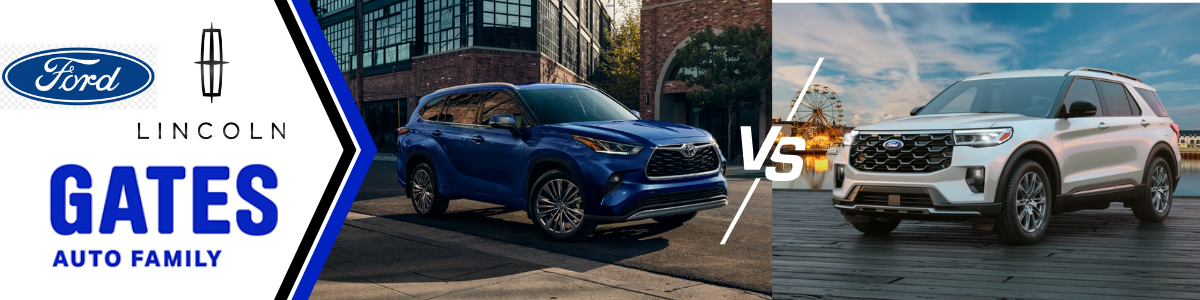
Two Three-Row Family SUVs Face Off for 2026
The family SUV search usually narrows down to the same handful of contenders, and two big names keep showing up in Kentucky driveways. Both the 2026 Toyota Highlander and 2026 Ford Explorer seat up to seven passengers, tow up to 5,000 pounds, and pack plenty of tech into their three-row cabins. Picking between them comes down to what you actually want out of daily driving, weekend hauling, and everything in between.
Before you start shopping, here are three quick hits worth knowing.
- The Toyota Highlander vs. Ford Explorer matchup puts a fuel-sipping turbo four against a wider range of engines and a sportier driving feel.
- Ford offers six trim levels for 2026, including a new off-road Tremor, while Toyota keeps things simpler with four gas trims plus three hybrid grades.
- Toyota makes all-wheel drive standard on every gas Highlander for 2026, while Ford still lets you start the Explorer with rear-wheel drive and add four-wheel drive later.
How They Stack Up Under the Hood
Toyota keeps things simple with a turbocharged 2.4-liter four-cylinder in every gas Highlander, making 265 horsepower and 310 pound-feet of torque. Paired with an eight-speed automatic and standard all-wheel drive on all gas trims for 2026, the Highlander tops out at a 5,000-pound tow rating. If you’d rather sip fuel, Toyota also sells a hybrid version with a 2.5-liter gas engine and electric motor combo good for 243 combined horsepower and roughly 35 mpg combined.
Ford takes a more varied approach. The 2.3-liter EcoBoost turbo four handles duty on the Active, ST-Line, Platinum, and base Tremor, producing 300 horsepower and 310 pound-feet of torque. Want real muscle? The 3.0-liter EcoBoost V6 in the ST (and available on the Tremor) produces 385 horsepower and 415 pound-feet of torque. A 10-speed automatic handles shifts across the board, rear-wheel drive is standard on most trims, and intelligent four-wheel drive is available.
Fuel economy-wise, the base Explorer rates 20 city and 29 highway with RWD, edging the Highlander’s 21/28 numbers on the interstate. The Highlander Hybrid walks away with the combined-mpg crown, though, at around 35.
Interior Space and Tech Tools
Both SUVs offer three rows, but the Explorer stretches out a touch more on paper. It measures 198.7 inches long, compared to the Highlander’s 194.9 inches. Max cargo room goes to Ford at 85.8 cubic feet versus Toyota’s 84 cubic feet with all seats folded. The Highlander ships standard with second-row captain’s chairs for seven-passenger seating, with an optional bench swapping in on XLE and Limited grades to bump capacity to eight. Ford mirrors that setup with available captain’s chairs on the Explorer.
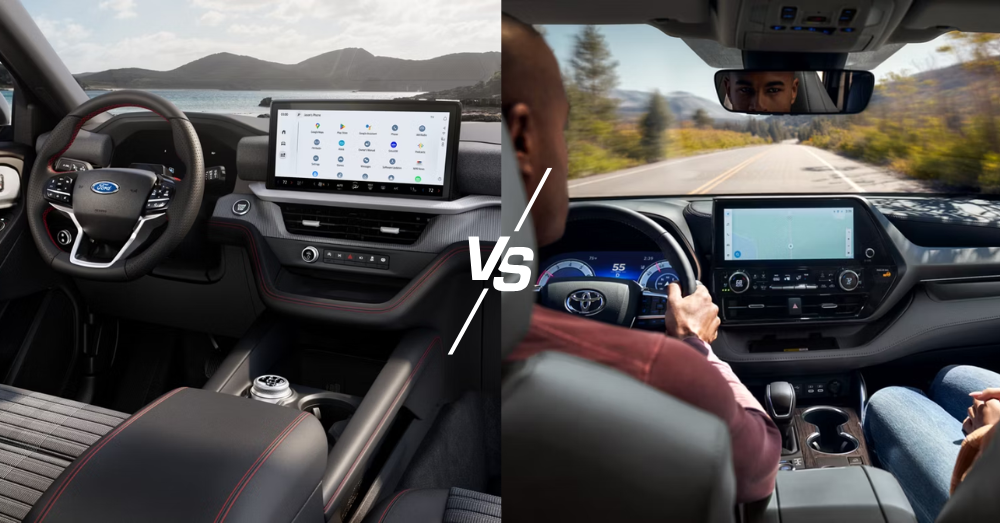
Tech is where Ford flexes hardest. Every 2026 Explorer ships with a 13.2-inch touchscreen running the Ford Digital Experience, which pulls in Google Maps, Google Assistant, and Google Play apps right on the dash. Toyota starts with an 8-inch screen with wireless Apple CarPlay and Android Auto, and upgrades to a 12.3-inch display on Limited and Platinum grades. Both systems work well, but Ford’s setup feels a step ahead in screen real estate and built-in Google integration.
2026 Toyota Highlander vs. 2026 Ford Explorer Spec Breakdown
| Category | 2026 Toyota Highlander | 2026 Ford Explorer |
|---|---|---|
| TRIM LINEUP | ||
| Entry | XLE: 2.4L turbo, standard AWD, 8-in screen | Active 100A and Active: Standard 13.2-in screen |
| Sport Styling | XSE: Sport-tuned suspension, 20-in wheels, JBL audio | ST-Line: Sport body kit, 20-in wheels, sport seats |
| Off-Road | Not offered | Tremor: Lifted suspension, skid plates, Torsen rear axle |
| Luxury | Limited: Leather, heated and ventilated front seats | Platinum: Multicontour massaging leather, B&O audio |
| Performance Top | Platinum: Head-up display, panoramic roof | ST: 3.0L V6, paddle shifters, sport chassis |
| Hybrid Grades | Hybrid XLE, Hybrid Limited, Hybrid Platinum | Not available |
| ENGINE & DRIVETRAIN | ||
| Standard Engine | 2.4L Turbocharged I-4 | 2.3L EcoBoost Turbocharged I-4 |
| Base Horsepower | 265 hp | 300 hp |
| Base Torque | 310 lb-ft | 310 lb-ft |
| Optional Top Engine | None (same gas engine across trims) | 3.0L EcoBoost Twin-Turbo V6 (385 hp / 415 lb-ft) |
| Hybrid Powertrain | 2.5L hybrid, 243 combined hp | Not offered |
| Transmission | 8-speed automatic (gas); eCVT (hybrid) | 10-speed automatic |
| Standard Drivetrain | AWD on all gas trims (new for 2026) | RWD (Intelligent 4WD available; standard on Tremor) |
| Max Towing (properly equipped) | 5,000 lbs (gas); 3,500 lbs (hybrid) | 5,000 lbs (both engines) |
| Fuel Economy (EPA est.) | 21 city / 28 hwy (gas AWD); ~35 combined (hybrid) | 20 city / 29 hwy (2.3L RWD) |
| DIMENSIONS & CARGO | ||
| Length | 194.9 in | 198.7 in |
| Passenger Capacity | Up to 8 (with optional bench seat) | Up to 7 (6 with captain’s chairs) |
| Cargo Behind 3rd Row | 16 cu ft | 16.3 cu ft |
| Max Cargo (all seats folded) | 84 cu ft | 85.8 cu ft |
| INFOTAINMENT & TECH | ||
| Standard Touchscreen | 8-inch | 13.2-inch (all trims) |
| Top Touchscreen | 12.3-inch (Limited, Platinum) | 13.2-inch (same across lineup) |
| Wireless CarPlay/Android Auto | Standard | Standard |
| Built-in Google Apps | Not offered | Standard (Maps, Assistant, Play Store) |
| Premium Audio | 11-speaker JBL (XSE and up) | 14-speaker B&O (available on ST) |
| SAFETY & DRIVER ASSIST | ||
| Standard ADAS Suite | Toyota Safety Sense 2.5+ | Ford Co-Pilot360 |
| Adaptive Cruise Control | Standard | Standard |
| Blind-Spot Monitor | Standard | Standard |
| Surround-View Camera | Standard on Platinum | Available on ST-Line and up |
| Hands-Free Highway Driving | Not offered | BlueCruise 1.5 available on all six trims |
| Head-Up Display | Standard on Platinum | Available on Platinum and ST |
How Each SUV Keeps You Safer
Every Highlander gets Toyota Safety Sense 2.5+ as standard kit, bundling adaptive cruise control, lane-centering steering, forward-collision warning with pedestrian detection, blind-spot monitors, and rear cross-traffic alert. Step up to the Platinum, and you get a surround-view camera, a head-up display, and adaptive headlights.
On the Ford side, Co-Pilot360 matches the Toyota suite feature for feature. The real bonus on the Explorer is BlueCruise 1.5, Ford’s hands-free highway driving system, which is available across all six trims and now includes Automatic Lane Change. You can set cruise, drop your hands off the wheel on pre-mapped highways, and let the Explorer handle the lane changes when traffic slows ahead. That’s a perk Toyota doesn’t match today.
Where Each SUV Earns Its Keep
Buyers who want one-and-done simplicity and a hybrid that cracks 35 mpg combined should start with the Highlander. Toyota has a reputation for quiet, predictable three-row vehicles that rack up miles without much drama. Ford opens up more choices. Want rear-wheel drive to keep the entry point lower? That’s there. The V6 in the ST gives you real passing power, and the new Tremor adds off-road hardware for weekend trips out to the Red River Gorge. Two capable family SUVs, two different roads to the same school pickup line.
See the 2026 Explorer at Gates Ford Lincoln in Richmond
At Gates Ford Lincoln, we stock the full 2026 Explorer lineup so you can see the differences for yourself instead of reading about them. Want to feel the V6 pull of the ST or check out the new Tremor trim’s off-road hardware up close? We can set you up with a back-to-back test drive on the same afternoon. Our team also helps you sort through BlueCruise subscription options, trailer tow packages, and financing before you make the jump. Swing by the showroom, take the Explorer for a spin, and let us help you figure out whether this is the three-row SUV worth parking in your driveway for the next decade.
Connect with us


