7 Standout Features of the 2021 Ford EcoSport
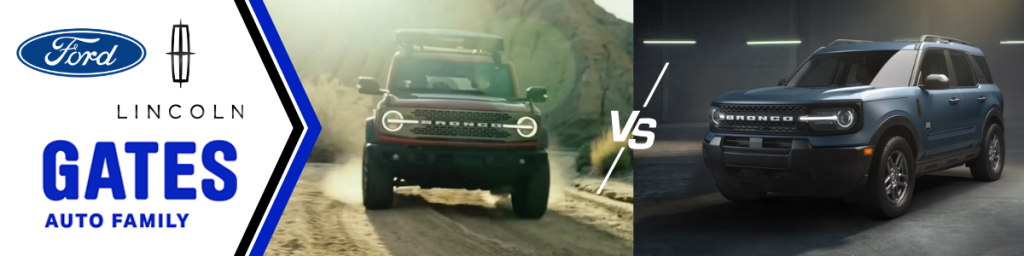
Two Ford SUVs That Share a Badge and Almost Nothing Underneath Shoppers walk onto the lot assuming one of these is simply the smaller version of the other. That guess costs money, because the two answer completely different questions. One is built around removable doors and a solid rear axle. The other is a five-passenger crossover that happens to wear the same lettering across its grille. Three turbocharged engines are offered across the full-size Bronco lineup, compared to two for the Bronco Sport. Ground clearance ranges from 7.8 inches on most Bronco Sport trims up to 13.1 inches on the Bronco Raptor. Towing tops out at 2,700 pounds for the Bronco Sport Badlands and 4,500 pounds for the Bronco Raptor. Body Style Is the First Fork in the Road Every 2026 Bronco Sport is a four-door crossover with a fixed roof and five seats. Nothing comes off. Its bigger sibling flips that script. Base and Badlands trims can be ordered as two-door or four-door models, and Ford builds both with removable doors and a removable roof. Two-door models seat four; four-door models seat five. Roof choices show how far apart these two sit. Two-door Broncos come with a hard top; four-door Broncos get a soft top; and a dual-top setup can be added to any model. The Bronco Sport doesn't offer any of that, though its safari-style roofline makes up for some of the loss in headroom. Engine Choices Split the Lineups Fast Anyone weighing a Ford Bronco vs. Bronco Sport purchase should start with the powertrains, since they don't overlap by a single cubic inch. Bronco Sport runs either a 1.5L EcoBoost three-cylinder making 180 horsepower and 200 lb-ft, or the Badlands 2.0L EcoBoost four-cylinder making 250 horsepower and 280 lb-ft. Both use an eight-speed automatic. Step up to the Bronco, and the numbers jump. Its 2.3L EcoBoost four-cylinder makes 300 horsepower and 325 lb-ft on premium fuel, the available 2.7L EcoBoost V6 climbs to 330 horsepower and 415 lb-ft, and Raptor gets a 3.0L V6 good for 418 horsepower and 440 lb-ft. Ford still sells a seven-speed manual on Base, Big Bend, Badlands, and Heritage Edition, which is rare air in 2026. Terrain Hardware Separates Them Further Both SUVs use G.O.A.T. Modes, Ford's terrain management system. Bronco Sport runs five modes on Big Bend, Heritage, and Outer Banks, seven on Badlands. The full-size lineup saves its seven-mode setup for Badlands, Stroppe Edition, and Raptor. Water fording is where the gap gets wide. Ford rates the Bronco at 33.5 inches and the Raptor at 37. Bronco Sport handles 24 when properly equipped. That's a real difference if you cross creeks, and a meaningless one if you cross parking lots. 2026 Ford Bronco and Bronco Sport Trim Comparison Trim Engine HP / Torque Transmission Ground Clearance Max Towing G.O.A.T. Modes Body / Seating 2026 Ford Bronco Sport Big Bend 1.5L EcoBoost I-3 180 hp / 200 lb-ft 8-speed automatic 7.8 in. 2,200 lb (Class II pkg.) 5 4-door, seats 5 Heritage 1.5L EcoBoost I-3 180 hp / 200 lb-ft 8-speed automatic 7.8 in. 2,200 lb (Class II pkg.) 5 4-door, seats 5 Outer Banks 1.5L EcoBoost I-3 180 hp / 200 lb-ft 8-speed automatic 7.8 in. 2,200 lb (Class II pkg.) 5 4-door, seats 5 Badlands 2.0L EcoBoost I-4 250 hp / 280 lb-ft 8-speed automatic 8.1 in. 2,700 lb (Class II std.) 7 4-door, seats 5 2026 Ford Bronco Base 2.3L EcoBoost I-4 300 hp / 325 lb-ft 7-speed manual, available 10-speed automatic 8.3 in. 2-door, 8.4 in. 4-door (11.6 / 11.5 in. w/ Sasquatch) 3,500 lb (Class II pkg.) 5 2-door seats 4, 4-door seats 5 Big Bend 2.3L EcoBoost I-4 300 hp / 325 lb-ft 7-speed manual, available 10-speed automatic 8.4 in. (11.5 in. w/ Sasquatch) 3,500 lb (Class II pkg.) 5 4-door, seats 5 Outer Banks 2.3L EcoBoost I-4, available 2.7L EcoBoost V6 300 hp / 325 lb-ft, or 330 hp / 415 lb-ft 10-speed automatic 8.4 in. (11.5 in. w/ Sasquatch) 3,500 lb (Class II pkg.) 5 4-door, seats 5 Badlands 2.3L EcoBoost I-4, available 2.7L EcoBoost V6 300 hp / 325 lb-ft, or 330 hp / 415 lb-ft 7-speed manual, available 10-speed automatic 10.5 in. (11.6 / 11.5 in. w/ Sasquatch) 3,500 lb (Class II pkg.) 7 2-door seats 4, 4-door seats 5 Heritage Edition 2.3L EcoBoost I-4, available 2.7L EcoBoost V6 300 hp / 325 lb-ft, or 330 hp / 415 lb-ft 7-speed manual or 10-speed automatic 11.5 in. (Sasquatch standard) 3,500 lb (Class II pkg.) 5 4-door, seats 5 Stroppe Edition 2.7L EcoBoost V6 330 hp / 415 lb-ft 10-speed automatic 11.5 in. 3,500 lb (Class II pkg.) 7 4-door, seats 5 Raptor 3.0L EcoBoost V6 418 hp / 440 lb-ft 10-speed automatic 13.1 in. 4,500 lb (tow pkg. standard) 7 4-door, seats 5 Horsepower and torque based on premium fuel per SAE J1349, and are independent attributes that may not be achieved at the same time. Towing requires the noted equipment. Specifications from ford.com, August 2026. Fuel Economy Swings Hard Toward the Smaller SUV Ford rates the 1.5L Bronco Sport at 25 city, 30 highway, and 27 combined mpg with standard 4x4. The Badlands and its 2.0L land at 21 city, 27 highway, and 23 combined. Adding the Sasquatch package to an Outer Banks drops the 1.5L to 23 city, 26 highway, and 24 combined. Ford lists the 2026 Bronco as not yet EPA rated at the time of release, so there aren't official numbers to quote yet. Curb weights tell you enough anyway: roughly 3,458 pounds for a 1.5L Bronco Sport versus 4,332 pounds for a base Bronco. Cargo Space Isn't the Slam Dunk You'd Guess A four-door Bronco with a hard top holds 35.6 cubic feet behind the second row and 77.6 cubic feet with those seats folded. Bronco Sport counters with 32.5 cubic feet behind the second row on 1.5L models and a maximum of 65.2 cubic feet. The Bronco Sport Badlands drops to 29.4 and 60.6. Two-door Bronco buyers give up plenty. Figure 20.6 cubic feet behind the rear seats and 52.0 cubic feet total, less usable room than the smallest Bronco Sport. Matching the Badge to Your Weekly Mileage Ask yourself what happens on a normal Tuesday. School pickup, a grocery run, and maybe a gravel road to a trailhead? Bronco Sport Big Bend or Outer Banks covers all of that while sipping fuel. Hauling a boat, climbing a rutted access road, or itching to drive with the doors off? Then the full-size Bronco earns its keep, and Badlands hits the sweet spot for most trail-minded buyers. Compare Both Broncos in Person at Gates Ford Lincoln Spec sheets only take you so far. We keep both the Bronco and Bronco Sport in our Richmond lot, so you can climb into each one back-to-back and feel the difference in ride height, cabin size, and visibility. Our team will walk you through which trims pair with the Sasquatch package, what the Class II Trailer Tow Package adds, and whether that manual is worth chasing. We'll set up test drives in both and help match trims to your budget. Shoppers from Lexington, Nicholasville, and across central Kentucky come to us for exactly this kind of comparison.
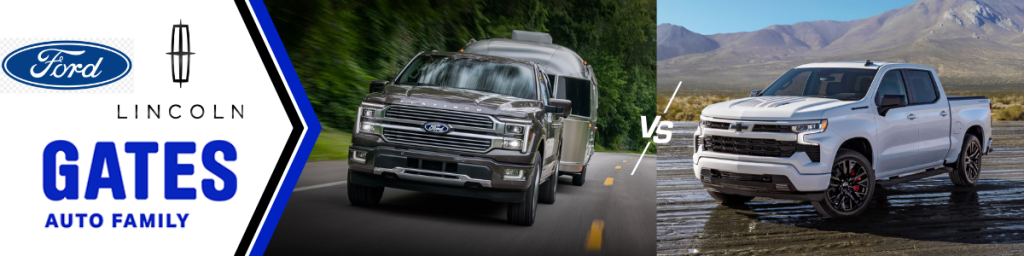
Picking Between America's Two Favorite Pickups Walk through any jobsite parking lot in Kentucky, and you'll count more blue ovals and bowties than everything else put together. That's no accident. Both brands have spent decades sharpening their half-ton trucks for drivers who pull a horse trailer on Saturday and run the school route on Monday. For 2026, the answers hide in the trim ladder rather than the badge. Ford fields six engines across the F-150 lineup while Chevy counters with four, including the only diesel offered in the half-ton class. Maximum towing lands at 13,500 pounds for the F-150 and 13,300 pounds for the Silverado 1500, though both figures demand very specific configurations. Trim pricing runs $37,290 to $79,005 on the Ford side and $36,900 to $71,800 on the Chevy side, excluding destination. What Sits Under the Hood Ford starts the F-150 with a 2.7L EcoBoost twin-turbo V6 rated at 325 hp and 400 lb-ft, then piles options on top. There's a 5.0L V8 good for 400 hp and 410 lb-ft, a 3.5L EcoBoost twin-turbo V6 at 400 hp and 500 lb-ft, and the 3.5L PowerBoost full hybrid making 430 hp and 578 lb-ft combined. Raptor buyers get a 450 hp high-output 3.5L, and the Raptor R runs a supercharged 5.2L V8 worth 720 hp. All of them route through a 10-speed automatic. Chevy keeps the menu shorter. A 2.7L TurboMax four-cylinder makes 310 hp and 430 lb-ft through an 8-speed automatic, the odd one out since every other Silverado engine uses a 10-speed. From there, you can pick the 5.3L V8 at 355 hp and 383 lb-ft, the 6.2L V8 at 420 hp and 460 lb-ft, or the 3.0L Duramax turbo-diesel inline-six making 305 hp and 495 lb-ft. That diesel has no direct rival among half-tons, and it's why plenty of shoppers put a Silverado on the list at all. Towing Numbers Worth Reading Twice Ford's headline is 13,500 pounds, and reaching it takes the 3.5L EcoBoost, a SuperCrew cab, 4WD, the 6.5-foot bed, and the Max Trailer Tow Package. Chevy's best is 13,300 pounds using the Duramax in a Double Cab with the standard bed and 20-inch wheels. Two hundred pounds apart, or roughly one heavy passenger. Payload tips toward Ford at 2,440 pounds, compared with 2,260. Shopping the 2026 Ford F-150 vs. Chevy Silverado on pulling power? Watch how that torque behaves instead of chasing the peak number. Chevy's diesel hands over 495 lb-ft low and stays flat. Ford's 3.5L EcoBoost puts its 500 lb-ft down with a shove once the turbos wake. Neither is wrong. They just feel different with 9,000 pounds behind you on I-75. Fuel Economy Swings Hard by Engine Nothing splits these trucks like your engine choice. Chevy's 2WD Duramax posts EPA estimates of 23 city and 28 highway, for a combined 25, the best set of numbers in any half-ton. Ford counters with the PowerBoost hybrid at 22 city, 24 highway, and 23 combined in 4WD form, and it carries Pro Power Onboard as a jobsite generator. Gas V8s land where you'd guess. Chevy's 5.3L in 2WD returns 17 combined against 19 combined for Ford's 5.0L in 2WD. 2026 F-150 and Silverado 1500 Trim Comparison Chart Segment Ford F-150 Trim Chevy Silverado 1500 Trim What Separates Them Work Truck XL, $37,290 WT, $36,900 F-150 XL includes a 12-inch touchscreen and 12-inch digital cluster. Silverado WT uses a smaller display. Second Rung STX, $41,510 Custom, $42,400 STX opens the door to the hybrid and the new Lobo Package. Custom adds keyless entry and power locks. Volume Seller XLT, $44,500 LT, $47,900 XLT undercuts LT by $3,400. LT is where Chevy's 13.4-inch screen and EZ Lift tailgate arrive. Street Sport STX with Lobo Package, from $41,510 RST, $51,300 Lobo is a lowered SuperCrew 4WD build with the 5.0L V8. RST leans on body-color trim and the 2.7L TurboMax. Leather Step-Up Lariat, $53,135 LTZ, $58,000 Lariat now starts as RWD for 2026, which drops its price. LTZ makes the 5.3L V8 standard. Off-Road Tremor, $58,115 Custom Trail Boss, $52,900 / LT Trail Boss, $59,700 Tremor comes with 4WD standard. Trail Boss trims stack, a lift, and skid plates on cheaper starting points. Top Luxury King Ranch, $60,960 / Platinum, $63,575 High Country, $62,900 Ford splits the top end into two personalities. Chevy runs one flagship with the 6.2L V8 available in 4x4. Extreme Off-Road Raptor, $79,005 ZR2, $71,800 Raptor packs 450 hp and desert-runner suspension. ZR2 pairs the 6.2L V8 with 11.2 inches of ground clearance. All MSRPs exclude destination and reflect the lowest-cost cab, bed, and drivetrain configuration per trim. Ford's site is currently showing promotional employee pricing on most trims, so confirm the current MSRP with your dealer before ordering. Some pricing may be promotional. Double check current manufacturer's pricing for an up-to-date MSPR. Screens, Beds, and the Stuff You Touch Daily Ford put a 12-inch touchscreen and a 12-inch digital gauge cluster in every 2026 F-150, base XL included, running SYNC 4 with a 5G modem that's now standard. Chevy holds its 13.4-inch display with Google built in for LT and above, so Work Truck and Custom shoppers settle for something smaller. Both include wireless Apple CarPlay and Android Auto. Chevy fires back on cargo. Its Durabed measures 89.1 cubic feet, a figure Chevrolet calls best in class, with 12 tie-downs rated at 500 pounds per corner. Ford answers with bed lengths of 5.5, 6.5, and 8.0 feet. Where Each Truck Earns Its Keep Buy the Silverado if the diesel range fits your week, or you want the biggest bed available without stepping up to a heavy-duty. Buy the F-150 if you want six engines to choose from, a hybrid that powers your tools, and a big screen even on the cheap trims. Neither truck is a bad call. Whichever trim you land on shapes your day-to-day far more than the emblem on the tailgate does, so price out the exact build you'd actually order and go sit in both. Why Buy Your Next F-150 at Gates Ford Lincoln Spec sheets only take you so far. We keep a wide mix of F-150 configurations on the ground in Richmond, so you can climb into an XLT SuperCrew and a Lariat back-to-back and feel the difference yourself. Our team can break down what the Max Trailer Tow Package adds to your rating, or whether the PowerBoost hybrid pencils out for your miles. Factory-trained technicians and genuine Ford parts keep your truck working hard long after you sign. Come drive a couple and settle this one on your own terms.
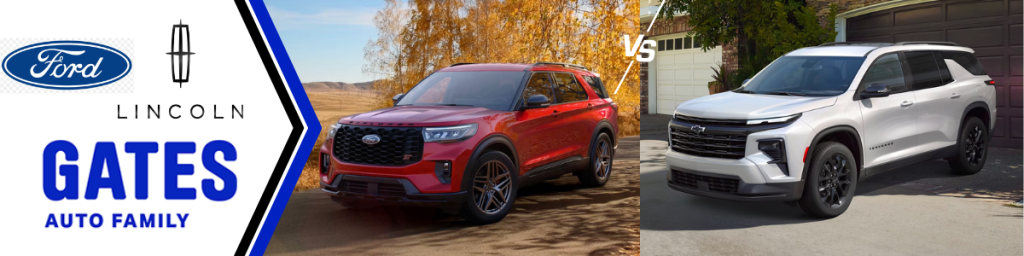
Picking Between Two Three-Row Family Haulers for 2026 Shopping for a three-row SUV that hauls kids, gear, and the occasional trailer can feel like a coin flip when two strong options sit side by side. Both of these Chevy and Ford crossovers earned their spots in driveways across the country, and each plays to a different kind of buyer. Let's break down what sets them apart so you can walk into a showroom knowing what you want. The Ford brings two turbocharged engine choices and a Tremor off-road trim, while the Chevy sticks with one strong turbo four across the board. Chevy's roomier cabin and bigger cargo hold make it the better pick for families who haul a lot of stuff. Both SUVs tow 5,000 pounds and pack hands-free highway driving tech on higher trims. The 2026 Ford Explorer vs. Chevy Traverse matchup pits two midsize three-row SUVs that share a mission but go about it differently. One leans into driving feel and engine variety. The other doubles down on space. Which one fits comes down to a few real differences. What's Under the Hood Ford gives you a choice here, and that matters. The standard 2.3L EcoBoost four-cylinder makes 300 horsepower and 310 lb-ft of torque with a 10-speed automatic. Want more muscle? Step up to the available 3.0L twin-turbo V6, which Ford markets at up to 385 horsepower. Rear-wheel drive comes standard, and four-wheel drive is available across the lineup. Chevy keeps things simpler. Every Traverse runs a 2.5L turbocharged four-cylinder good for 328 horsepower and 326 lb-ft of torque, paired with an 8-speed automatic. Front-wheel drive is standard on most trims. All-wheel drive is optional or standard, depending on the trim, and the Z71 gets AWD standard with a twin-clutch system built for light off-road work. So the Chevy out-muscles the base Ford engine. But the Ford's optional V6 climbs well past it for serious grunt. If you tow or like a quick highway launch, that V6 is worth a test drive. Room for People and Cargo Here's where the Traverse pulls ahead for big families. Chevy seats up to eight with the second-row bench, and the cargo numbers are generous. You get 22.9 cubic feet behind the third row, 56.6 behind the second, and 98 cubic feet with everything folded flat. The Explorer seats six or seven, depending on your second-row setup. Its cargo space measures 16.3 cubic feet behind the third row, opening up to 85.8 cubic feet with all seats down. That's plenty for most weekend trips, but the Chevy's extra room adds up fast once you pile in coolers, strollers, and sports gear. Fuel Economy and Towing The base Explorer with rear-wheel drive earns an EPA-estimated 20 mpg city and 29 mpg highway. That's solid for a vehicle this size. Adding four-wheel drive or the V6 brings those numbers down a bit, as you'd expect. The Traverse posts 20 mpg city and 26 mpg highway with front-wheel drive, dropping slightly with AWD. Chevy's pressroom lists a 27 mpg highway figure, so confirm the sticker when you visit. Both SUVs tow up to 5,000 pounds. The Explorer includes a Class III Tow Package on every trim, handy if a small boat or camper is in your future. Tech and Driver Assistance Both SUVs come loaded with screens and safety gear. The Explorer runs a 13.2-inch center touchscreen with the Ford Digital Experience, wireless Apple CarPlay, and Android Auto. BlueCruise hands-free highway driving shows up on higher trims. Chevy answers with a big 17.7-inch touchscreen standard across every trim, Google Built-in, and the Super Cruise hands-free system on top models. Each brand stacks its lower trims with forward collision warning, automatic emergency braking, blind spot monitoring, and adaptive cruise control. You're covered no matter which badge you choose. 2026 Ford Explorer vs. Chevy Traverse Trim Comparison Feature 2026 Ford Explorer 2026 Chevy Traverse Starting MSRP $38,465 $40,800 Base Engine 2.3L turbo I-4 2.5L turbo I-4 Base Horsepower 300 hp 328 hp Available Engine 3.0L twin-turbo V6 (up to 385 hp) None Transmission 10-speed automatic 8-speed automatic Drivetrain RWD standard, 4WD available FWD standard, AWD available Seating Capacity 6 to 7 7 to 8 Max Cargo Volume 85.8 cu ft 98 cu ft EPA City/Hwy (base) 20/29 mpg (RWD) 20/26 mpg (FWD) Max Towing 5,000 lbs 5,000 lbs Center Touchscreen 13.2-inch 17.7-inch Hands-Free Driving BlueCruise Super Cruise Off-Road Trim Tremor (4WD) Z71 (AWD) Pricing reflects starting MSRP excluding destination charges. Verify current pricing and EPA figures with your dealer, since promotions and final ratings can shift. 2026 Ford Explorer Trim Ladder Trim Starting MSRP Drivetrain Highlights Active 100A $38,465 RWD, 4WD avail. Co-Pilot360 Assist+, 18-inch wheels, second-row captain's chairs Active $40,585 RWD, 4WD avail. Adds heated front seats, available fog lights ST-Line $45,155 RWD, 4WD avail. Sport styling, 20-inch wheels, heated steering wheel, Bang & Olufsen audio Tremor $48,965 4WD only Off-road suspension, skid plates, all-terrain tires, ventilated and heated seats Platinum $50,965 RWD, 4WD avail. 14-speaker B&O audio, standard BlueCruise, 21-inch wheels, massaging front seats ST $54,905 RWD, 4WD avail. Standard 3.0L twin-turbo V6, quad exhaust, ambient lighting, standard BlueCruise 2026 Chevy Traverse Trim Ladder Trim Starting MSRP Drivetrain Highlights LT $40,800 FWD, AWD avail. 17.7-inch touchscreen, up to 8 seats, Chevy Safety Assist, heated front seats Z71 $48,900 AWD standard Twin-clutch AWD, off-road suspension, skid plate, all-terrain tires, hill descent control High Country $55,100 FWD, AWD avail. Leather, ventilated seats, Super Cruise, Bose audio, 22-inch wheels RS $55,400 FWD, AWD avail. Sport styling, blacked-out accents, flat-bottom wheel, 22-inch wheels, Super Cruise Explorer prices start with rear-wheel drive, with four-wheel drive adding about $2,000 on most trims. Traverse High Country and RS all-wheel-drive versions start at $57,100 and $57,400, respectively. Confirm trim pricing with your dealer. Which One Fits Your Driveway Your choice comes down to priorities. Pick the Explorer if you want a sportier drive, a punchy optional V6, or a real off-road option in the Tremor. It suits folks who care how a vehicle feels behind the wheel and want a trim ladder to climb. Go with the Traverse if maximum passenger and cargo room top your list, or if that giant standard touchscreen and eight-seat capacity speak to your busy household. Both are smart buys, so park them side by side and see which cabin feels like home. See the 2026 Explorer Up Close at Gates Ford Lincoln We'd love to help you sort through everything that goes into picking the right three-row SUV. At Gates Ford Lincoln in Richmond, our team knows the Explorer lineup inside and out, from the rear-wheel-drive Active up to the V6-powered ST and the trail-ready Tremor. Stop by to climb through the second and third rows, fold the seats down, and take one out on the road so you can feel the difference yourself. We're glad to walk you through trims, drivetrains, and towing setups. Come see why so many Kentucky families trust us with their next SUV.
Although every reasonable effort has been made to ensure the accuracy of the information contained on this site, absolute accuracy cannot be guaranteed. This site, and all information and materials appearing on it, are presented to the user "as is" without warranty of any kind, either express or implied. All vehicles are subject to prior sale. Price does not include applicable tax, title, and license charges. ‡Vehicles shown at different locations are not currently in our inventory (Not in Stock) but can be made available to you at our location within a reasonable date from the time of your request, not to exceed one week.